Consider this.
It is Saturday morning (nearly Saturday afternoon) and we are at Woolworths.
This is, in itself, rather exciting. I am easily excited by supermarkets, and as we live over the road (nearly) from a Coles, Woolworths has a certain something that comes from not being in the store every second day.
This particular visit had already been heightened by the discovery of Lindt Excellence chocolate on sale for two blocks for $4.
I may have been semi-dancing down the aisles, and/or riding on the trolley as I pushed it.
(It is best to perform the trolley riding trick when there
are heavy items in the far end of the trolley. And to take a casual approach,
rather than careening down the aisles. Just in case you were wondering.)
Mr Bite then pointed out this tea as a possible point of
interest:
It was, indeed, a possible point of interest. I took a packet. I may have made a comment about there being an awful lot of tea in the packet if I didn’t end up liking it. We may want to keep that comment in
mind.
We continued our journey in the upbeat way that characterises our (my) supermarket trips, and then I saw these noodles:
My brain then veered off into temper tantrum territory, with my thoughts going something along the lines of “For goodness sakes, can we not just have noodles - why does everything need to have a low calorie version?! /
There is nothing WRONG with noodles in their current form / I really wish
people weren’t scared of carbohydrates…”.
And then I actually picked the packet up, to see what on earth they had done to the noodles to make them ‘super lo-cal’, and saw that they were not noodles in the traditional sense at all.
These noodles are made from Konjac root extract, and that suddenly changed my stance on the product altogether.
Given that they were now not a modified, fake version of noodles but a vegetable-derived noodle alternative, my brain backtracked and went down the “How interesting! I want to try them!” path.
Clearly I can be a little fickle in the supermarket.
This means that we returned home with two new products for
me to try.
Here are my conclusions.
Tetley’s tea for soy milk

I am still not entirely certain what they did to make these tea bags different to the non-soy milk variety. The labelling suggests that the
tea in question is slightly different, but why soy milk pairs better with "zingy high grown Kenyan" tea than with other black tea is a mystery to me.
I can attest, though, that these do work very well with soy
milk. There is no curdling in sight and the appearance of the tea is identical to when I make it with cow’s milk. Quite an impressive effort!
There is a downside, though, and that is that I don’t much like the flavour. Yes, that comment in the supermarket is now haunting me.
You see, I am a little fussy with black tea and would generally prefer to drink Earl Grey or English Breakfast black than a generic brand that I’m not fond of with milk. I fear that this soy variety, for all its soy-related benefits, may be going into the ‘brand I’m not fond of’ category. I will try it a few more times first, but I suspect it may linger in the pantry for a while.
My verdict? If you aren’t too worried about your brand of black tea, you think milk in tea is essential, and you like to drink soy milk, then these may be perfect. As for me, I’m now pinning my hopes on an instant coffee that works with soy milk…
Chang’s Super Lo-Cal Noodles

As noted, these are not your traditional wheat, rice or egg noodles. They are made from
Konjac root extract, which the internet helpfully told me may also be known as
Glucomannan. There seems to be a whole diet industry built around this product, which makes me think that these noodles are just the tip of the iceburg.
The fact that 100g (half a packet) of these provides just 44kj / 11 calories, with no fat or carbohydrate, highlights how much scope there is for diet-related advertising. One website noted that Konjac can
expand by up to 17x when eaten, which I found rather terrifying, but I suppose might appeal to those trying to fill themselves up on what is effectively fibre without calories.
With regard to what it actually is,
Wikipedia informed me that Konjac is a perennial plant that has large starchy stems, and that it is these that are used create Konjac flour and Konjac jelly. Konjac-derived noodles are apparently common in
Japan and are called shirataki there. Konjac can also provide a vegan alternative to gelatine.
When progressing to read about
Glucomannan itself, the name for the Konjac extract, I found myself getting a little concerned about what I had bought. Why? Well, there have been warnings issued about the importance of taking the extract with water or fluid, and that there are “risks of choking and/or blockage of the throat, oesophagus or intestine” if this doesn’t occur.
Fortunately the noodles consist of water and Konjac root extract but I still think, on balance, that I might prefer real noodles that can’t kill me.
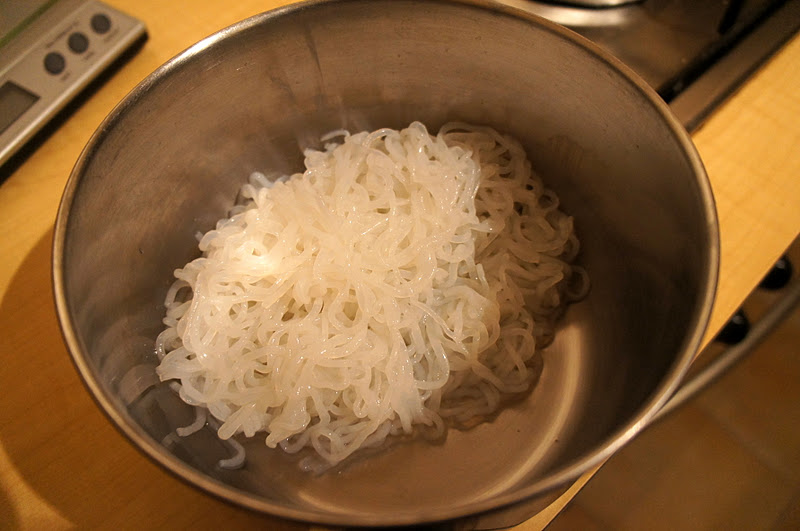
I did try these though, with left-over vegetable stir fry that I had originally served with rice. I cooked the noodles in simmering water for 5 to 10 minutes, and noted that whilst they looked identical to other noodles they had a slightly different smell. Sort of…earthier? Not exactly unpleasant, but perhaps not entirely appealing either.
When considering taste, they really don’t have one. This isn’t particularly unusual for Asian-style noodles, and the main difference from the regular variety (they reminded me most of thick rice noodles) is in the texture.
They are chewy yet firm, and biting through them to break the noodles up is pretty impossible. They also seemed a bit stodgy after a while, despite their low calorie nature (perhaps because they were expanding to 17x their size in my stomach and/or threatening to choke me from within? :/ ).
For people who were trying to lose weight, limit carbohydrates or avoid gluten, I can see that these may be quite beneficial. For myself, the fear of somehow dying a death from Konjac root might just put me off!
Have you heard of or tried Konjac-related products? What about tea for soy milk?