
You may imagine my dismay, therefore, when I read Angela's recent post on carrageenan over at Oh She Glows. Like Angela, I hadn't given any thought to carrageenan before having its possible effects pointed out to me. And like Angela, I was horrified to discover that it is used in vegan and organic foods (as well as non-vegan and non-organic ones) despite controversy over whether it is safe for humans to consume.
If you aren't familiar with carrageenan and haven't read Angela's post, I would recommend it. She also includes links to several articles and reviews that may help you make up your own mind about whether or not carrageenan is something you want to consume. In brief, my reading suggests that:
- Carrageenan is derived from red seaweed and is used as an emulsifier and thickener in many dairy and dairy replacement products.
- Carrageenan has two variants: a low molecular weight, "degraded" form and a high molecular weight, "undegraded" form.
- Degraded carrageenan is indisputably a carcinogen in rodents, and has been found to trigger inflammation of the colon in rodents in a way that mirrors irritable bowel disease (IBS) in humans.
- Undegraded carrageenan does not have these harmful effects, but every tested sample of undegraded carrageenan has had some level of contamination by degraded forms of the substance. In some cases this level of contamination reaches 25%.
- In light of (3) and (4), there have been suggestions that humans with IBS avoid all forms of carrageenan.
I don't have IBS, but I am still going to be avoiding carrageenan from now on. I am thus quite devastated that my beloved almond milk has carrageenan listed in the ingredient list. Unfortunately, all forms of Almond Breeze milk (at least those distributed in Australia) include carrageenan. I sent an email in to the company to express my dissatisfaction over their use of the ingredient, but haven't received a response and don't really expect to. I also found it particularly unfair that I discovered carrageenan in Almond Breeze products the very same week I discovered chocolate almond milk at the supermarket.
Update, 16th April 2013: I received an email in response to this post from the Australian Director for Blue Diamond Almond Breeze. He kindly took the time to explain the safety of food grade carrageenan, but the fact remains that food grade carrageenan is often contaminated with degraded carrageenan. After an email exchange on that issue, he indicated that he would read more on the topic and discuss with his American colleagues. It's not often I have that level of interaction with a company and whatever the outcome from here, I am delighted that they are at least considering their use of carrageenan and that they took the time to email me.
Update, 16th April 2013: I received an email in response to this post from the Australian Director for Blue Diamond Almond Breeze. He kindly took the time to explain the safety of food grade carrageenan, but the fact remains that food grade carrageenan is often contaminated with degraded carrageenan. After an email exchange on that issue, he indicated that he would read more on the topic and discuss with his American colleagues. It's not often I have that level of interaction with a company and whatever the outcome from here, I am delighted that they are at least considering their use of carrageenan and that they took the time to email me.
 |
| This could have been so good... |
Can you spot the problem ingredient in the ingredient list below?
 |
| Carrageenan: third line of the ingredients. |
I drank the above anyway, supposedly in the name of research, but my enjoyment was certainly compromised by new-found awareness of the ingredient list. This was a pity, because the milk could have been delightful - full-flavoured chocolate, sweet without being sickly, and creamy without being 'milky' in a traditional sense.
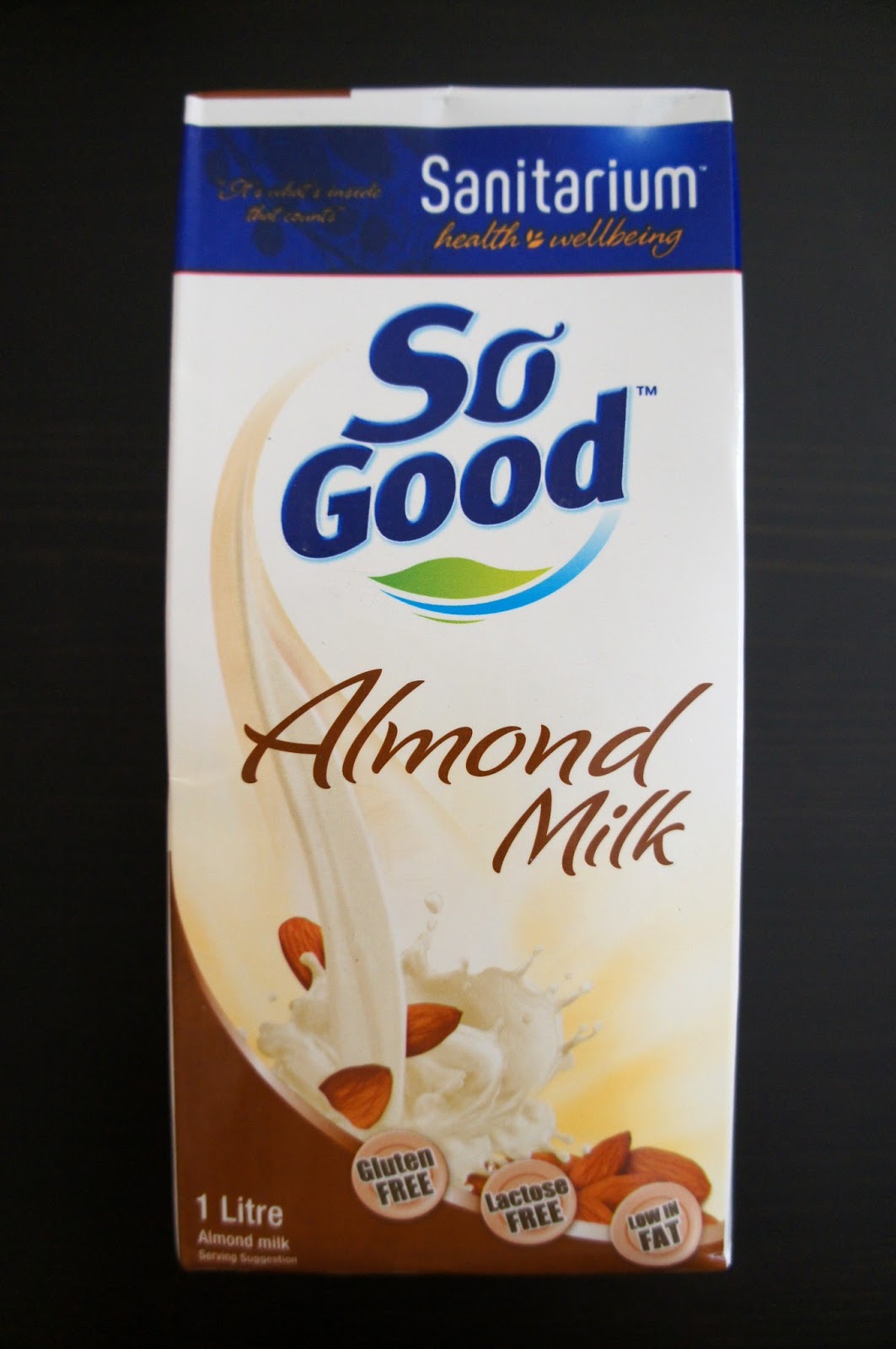
Alas, I moved on and have now crossed Almond Breeze off my drink list. This left me with the task of finding a replacement option for my coffee, and to a lesser extent smoothies and cereal. Initially, I thought I'd jump to Australia's Sanitarium So Good unsweetened almond milk. Sadly, they too include carrageenan in the ingredient list. There is no carrageenan in the sweetened Sanitarium almond milk and so that is what I have been using over the past few weeks. As of mid-2013, there is also carrageenan in the regular, sweetened Sanitarium almond milk.
I then thought I would return to the unsweetened So Delicious coconut milk I reviewed in December 2011, but alas! It is no longer in any supermarkets near me, including the one I found it in back then. And also! It has carrageenan in it too.
This week I switched back to soy milk and tried Vitasoy's Vita Cafe low fat soy milk. It has the advantage of coming in regular 1L cartons and 3-packs of smaller, 240ml tetrapacks. The latter are useful if you aren't sure if you'll like the milk, and/or want to take it to work.

I did actually like this, and it has been working in my coffee, which is something I've struggled with when using soy milk in the past. (I think my discovery of how to heat milk, and the need to use a reasonable amount of milk, may have helped with that.) At the same time, I would rather be drinking nut milk. I get enough soy in other forms. Update: See my note at the bottom of the post regarding carrageenan actually being included in this milk, but listed in the ingredient list as vegetable gum 407.
This return to milk frustration led me to try my hand at milk making once again. I haven't done much since I made hemp seed milk last November, largely because I have been happy with Almond Breeze. This time around, I tried cashew milk, because I had cashews sitting spare and I don't much like them on their own.

Basic cashew milk
Makes 3 cups cashew milk
This is a 'thin' milk, similar to low-fat or non-fat dairy milk in texture. If you like creamy milk, use less water to nuts or more nuts to water.
Vegan
Ingredients
1/2 cup raw cashews
3 cups water
Method
Soak the cashews in the 3 cups of water for 4 hours, or longer, in the refrigerator.
Transfer the nut/water mixture to a blender and process until creamy, about 30 seconds.
Strain the mixture through a nut milk bag or cheesecloth, and store in the refrigerator for up to 3 days.
Retain the nut 'pulp' left after straining for use in baking, if desired.

It's a magical process, milk making.
As with homemade hemp seed milk, I liked the experience of making this and I liked the result. The consistency was about right for me, it was satisfactorily not sweet, and it worked fine on cereal and in coffee. The downsides of the homemade route are that it will only last a few days, it's a bit harder to take a container into work for the week, and you don't get the added calcium that comes with commercial non-dairy milk varieties.

At this point, I don't feel like I have hit upon a 'perfect' replacement for Almond Breeze. I am keen for more non-dairy and non-carrageenan options to hit Australian shelves.
I have also updated my non-dairy milk comparison spreadsheet to include a column for whether or not carrageenan is present, and to incorporate chocolate Almond Breeze and VitaSoy vita cafe. I am repeating it below to highlight just how many milks do include carrageenan.
Update: Thanks to Mel from Veganise This, I know now that VitaSoy vita cafe does include carrageenan, but it is listed as vegetable gum 407. I am quite horrified by this. I have double-checked the other milks I've listed below as not including carrageenan, and they don't have carrageenan or vegetable gum 407 listed in their ingredient lists.
Update: Thanks to Mel from Veganise This, I know now that VitaSoy vita cafe does include carrageenan, but it is listed as vegetable gum 407. I am quite horrified by this. I have double-checked the other milks I've listed below as not including carrageenan, and they don't have carrageenan or vegetable gum 407 listed in their ingredient lists.
Do you avoid carrageenan?


