Wednesday, October 19, 2011

Australian food through the years

17 comments
Thank you, very much, for your comments on my last post. I have been amazed on so many occasions at the support out there in the blogging world - this time is no exception.

With this week being a slightly odd one, it seemed appropriate to do a different sort of post. And with my thoughts being somewhat retrospective, my mind turned to how food and cooking in Australia have changed over the last century or so.

Johanna at Green Gourmet Giraffe has touched on these issues eloquently before, particularly in this post, and I'm sure others have too. Three generations of Australian meals were also summarised beautifully on cityhippyfarmgirl. Thus, I hope I'm not repeating things too much here. As several full books have been written on the topic I thought I would take a gamble that my precise focus will differ sufficiently to the thoughts put down elsewhere!

Feel free to pick your era of interest, because this is rather long in its entirety...


The early 1900s and pre-World War II


·        Meat, potatoes, flour (bread), milk and tea were household staples.

·        Vegemite was developed in 1922 and first released in 1923, as a competitor to Marmite (available in England and New Zealand).  However, it didn’t sell well until the 1940s, at which time the yeast, salt, celery and onion extract combination became a household staple.


·        With the Great Depression hitting in 1929, many Australian cane growers were forced to leave their land. Italian immigrants were able to take advantage of this to buy plots with their savings, allowing them to start the gradual introduction of Italian foods and food styles to Australia. Vegetables such as zucchini, broccoli, eggplant, capsicum, and chillies were not traditionally known in Australia.

·        The depression also allowed rabbit to become a staple meat, cheaper than traditional alternatives.

·        Despite this, Australians still ate about three times more meat, including beef and lamb, in the 1930s than their American counterparts.

From Santich's (1955) "What the doctors ordered: 150 years of dietary advice in Australia"

·        The scientific study of food and nutrition became a political issue, and in 1936, the federal government established the Advisory Council on Nutrition.

·        This Council went on to publish a report stating that many Australians were at risk of malnutrition due to inadequate intake of dairy products and fresh fruits and vegetables.

·        Aeroplane jelly was developed in Melbourne in 1928 and became well known in 1939, when the ‘Aeroplane jelly’ song was released to radio.


World War II era (1940s)

·        With World War II came rationing, albeit at much lower levels than in Europe. Tea was rationed from June 1942, sugar from August 1942, and butter from June 1943.  

·        Advice was issued to suggest that all households should have one “meatless day per week”. This was reportedly not a recommendation that was popular at the time!

·        After the war, Australians became more American in their eating patterns. US troops had consolidated the role of existing US brands, and introduced new ones.

·        Kellogg’s and Kraft were two of the earliest names and soft drinks were a particularly novel introduction when they arrived. Coca cola became a popular and in demand drink.

·        The political focus on food and nutrition remained, and for a time, prunes (!) were only available for those who were unwell and for children. Vitamins became better understood and fruits and vegetables were promoted in addition to meat and milk.


·        Despite the shifts towards more American eating patterns, foods generally remained plain, including stews, roast meat with vegetables, bread, and scones.


  From Santich's (1955) "What the doctors ordered: 150 years of dietary advice in Australia"

  
1950s to 1960s

·        The Milk for School ChildrenAct was passed in 1950, giving all children under thirteen a free daily ration of milk.

·        Food was plentiful, especially when compared to war time rationing, but also when compared to other Western countries.

·        Households became better equipped for cooking and storing food, and between 75% and 90% (depending on the source) of homes had a refrigerator by 1960. Microwave ovens also became more common.


·        This was also the start of the supermarket era, shifting the previous pattern of shopping daily or near daily, and buying different foods from different stores. More convenience and packaged foods became available, including frozen foods and frozen vegetables.

·        Italian foods continued to grow in terms of recognition and availability. Cheeses like parmesan and ricotta, different pastas, olive oil, and tinned tomatoes all became more established. Coffee also grew in popularity, even to the point of overtaking tea.

·        In addition to standard meat dishes from previous decades (e.g., stews and roasts), newer styles like hamburgers, meatloaf, and crumbed cutlets became more common.

From Santich's (1955) "What the doctors ordered: 150 years of dietary advice in Australia"

1970s and 1980s

·        Immigration continued to impact on eating patterns, with diversification to include more European (Italian, Greek) and Asian (Chinese, Indian, Vietnamese) foods and dishes.

·        Electronic scanning arrived in Australian supermarkets in 1984. A jar of vegemite was reportedly the first product to be electronically scanned.

·        The low fat era hit, with more low fat recipes and low fat products being marketed, as society became more weight and health conscious.


·        Organisations like The HeartFoundation started to promote public health, and the Heart Foundation Tick was born.


From Santich's (1955) "What the doctors ordered: 150 years of dietary advice in Australia"


1990s

·        Rabbit started to make it back on to restaurant menus, overcoming the depression era reputation as a “poor” meat option.

·        There was a shift towards greater acceptance of vegetarianism, and of cultural differences around food (e.g., Halal, Kosher)

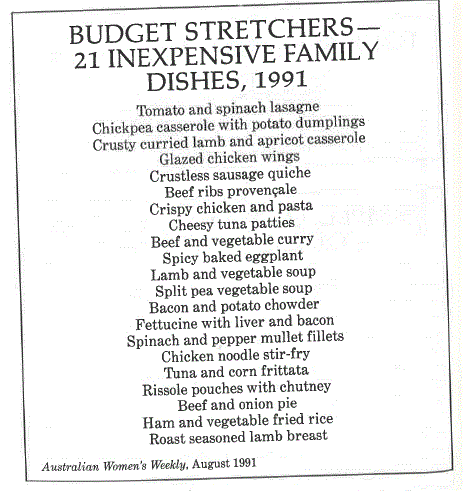
·        In line with this, even meat-based dishes started to include more vegetables, such as in lasagna or pasta dishes.


From Santich's (1955) "What the doctors ordered: 150 years of dietary advice in Australia"


·        In 1995, the Australian Bureau of Statistics conducted a national nutrition survey across all States and Territories. Bread and potatoes remained significant contributors to adult diets. About 80% of Australians ate red meat and/or poultry, and 90% consumed dairy products, the day before the survey.

2000s

·        The five food groups of cereals and grains, fruits and vegetables, meat, fish and alternatives, milk and dairy products, and fatty and sugary foods became increasingly promoted in public health campaigns.

·        Convenience and fast foods continued to grow and have an impact on supermarket purchasing, meal preparation at home, and restaurant / take away choices.

·        “Free” products became more and more common - fat free, sugar free, dairy free, gluten free, nut free…


And there we are! A snapshot summary of Australian food over the last 100 years or so - although quite literally only a snippet of the information out there.


What are your food memories? What has changed in your lifetime?


References used for the above:

  • Bosworth, M. (2003). Families and food: wartime tucker. Online.
  • Dyson, L. E. (2002). How to cook a galah. Thomas C Lothian Pty, South Melbourne.
  • Hayes, B. (1970). The Captain Cook book: Two hundred years of Australian cooking. Thomas Nelson, Sydney.
  • Santich, B. (1995). What the doctors ordered: 150 years of dietary advice in Australia. Hyland House Publishing, Melbourne, Australia.
  • Symons, M. (1982). One continuous picnic: A history of eating in Australia. Penguin Books, Melbourne, Australia.

Monday, October 17, 2011

An unexpected post

27 comments
I debated whether to write this, and then I debated whether to post it. Some things almost seem too personal for blogging. In the end, though, importance won out. At the end of the day, this is a blog about what is important to me. Mostly, that includes food and day-to-day trivialities. Sometimes, though, life creeps in.

And so, we have an unexpected post.

The reason? My paternal grandmother passed away yesterday.

This, in itself, wasn't entirely unexpected. She has had more health scares than I can count over the last 4 years or so, with many, many ambulance calls and hospital trips. She had a small stroke earlier this year, not long after celebrating her 90th birthday, and she transitioned from hospital to a nursing home after that stroke. Although she regained almost all functionality, it was getting clearer and clearer that her body was tiring out.

She had a larger stroke this last Saturday and never fully regained consciousness. She stopped breathing on Sunday afternoon.

I knew when leaving Victoria back in February, after visiting for the 90th birthday celebrations, that it may be the last time I saw her, or my 91-year-old grandfather. Despite this, the experience of death took me by surprise.

You see, in what I imagine is rare for someone in their mid (heading rapidly towards late...) 20's, prior to yesterday I had 4 grandparents, a full set of aunts and uncles, and no immediate friends who have died. Death isn't something that has affected people I know, or at least not those I have known directly. As I realise now, one-step-removed from death is very far removed.

It is odd, and disconcerting, and sad to think how quickly it occurs and how quickly things then change.

To think that she was alive on Saturday and not on Sunday. To think that my grandfather was a husband on Sunday morning and a widower on Sunday night. To think that my father had two parents living last week, and now has one.


I am, of course, grateful the experience came to me later than most. I was blessed to grow up with full sets of grandparents, and these ones, my Dad's, lived an hour from us until a few years ago. (At that point, the constant health scares and strain on my grandfather necessitated a move to a smaller house, and somewhere closer to one of their children. They elected to return to Victoria, where they raised their family and had more connections, and where they could still live in a small town, near my Dad's sister, rather than a city, where we are).

I am also aware that 90 is a grand age to reach, and leaving behind 4 children, 10 grandchildren and 7 great-grandchildren is pretty impressive.

But I am oh so conscious, this week, of how quickly things can change. The people I care about are suddenly more precious as a result. I realise, as I didn't fully realise before, that they could disappear at any time.

I also realise that what we leave behind when we go is limited, mostly, to the memories others hold.

For my Gran, I offer these ones. And thanks.


For looking after me whilst my brother was born, and taking me to my first day of kindergarten. 

For looking after me and my brother whilst my sister was born.

For having toys and children's books specifically for us, in a cupboard in your house.


For pikelets. Date slice. Chocolate chip biscuits that sometimes had ginger.

(I didn't like the ginger. But I liked the cookies a lot when the ginger was missing. It was a risky game, reaching for those biscuits.)

For making us clothes when were were young.

For teaching me and my sister how to make meringues.

For hiding Easter eggs in your garden for when we visited on Easter Sunday.

For picnics.


For looking after our childhood cat when we went on holiday.
And for feeding the cat liver, which meant he didn't want to come home.

For showing me that a marriage can still be cherished after 60 years.

For confirming that stubbornness is a family trait.

(I have it too.)

For showing me that even when you're stubborn, sometimes the body has had enough.


Rest in peace.

Saturday, October 15, 2011

The chocolate of fairytales

16 comments
When my parents returned from their travels, allowing us to cease house sitting and return to our usual residence, they returned with chocolate.

Quite exciting chocolate.

White Rabbit Chocolate from Yorkshire, England, to be precise.

This chocolate, for me:


And this chocolate, for Mr Bite:

I didn't get to photographing this before some of it was consumed!


I liked mine better. He liked his better. We were both happy.

The White Rabbit Chocolate Company is named for the carving of the Pilgrim Rabbit in Beverley, East Yorkshire, which is said to have inspired Lewis Carroll's White Rabbit in Alice in Wonderland.

Their chocolate seems suited to Alice in Wonderland.

The Harem Dream bar with Moroccan style spices consists of 70% cocoa dark chocolate with dried apricots, pumpkin seeds, rose fragments, and a 'spice mix' that includes black pepper.  The other spices aren't explicitly listed, but I think I detected faint chilli, or perhaps paprika, with some possible cinnamon or nutmeg.

The dried apricots, pumpkin seeds and rose fragments are what you see on the top of the 55g block, and aren't embedded within the chocolate itself. The spice mix, on the other hand, very much is.


It's subtle at first. The scent of the bar lets you know that something exciting is coming, but it's not immediately clear what or how strong that something is. On the first taste, the flavour is all chocolate. Deep and dark, but not bitter. Then it tingles just a little. The pepper comes through. Other spices follow.


My only point of comparison when trying to imagine the taste, before actually tasting it, was Lindt Excellence Dark Chocolate with Chilli (which is one of my favourite Lindt flavours). But it's not at all the same. Both are good, but where Lindt is smooth and sweet with a clear chilli hit, this is deep and dark with a more mellow and peppery spice mix.

Suffice to say, it was very good. Very, very good.

The Yorkshire honeycomb block was a milk variety, with 37% cocoa. The honeycomb bits were reportedly chewy, and were scattered throughout the block rather than forming a constant filling or lining up in squares. The ingredient list also cited golden syrup.


To my amazement but slight dismay (because I am not in England, and definitely not in Yorkshire) Googling revealed that there are several other flavours I would quite like to try.

The Nutty Gorilla Dark Chocolate, for example, which includes "dark chocolate with pecans, dates, walnuts and cocoa nibs".


Or just about any of the blocks featured in this image:


For now, though, I am happy to stick with my Moroccan Style Spice combination. I think it sums up so much of what can be wonderful about chocolate - the potential for fun, play, and even fairytale-esque flavours.

--

Bonus question: Are you a camera expert, or have you bought a camera recently? I am looking at upgrading my very basic Sony point and shoot and would be grateful for any advice! My current shortlist has settled on interchangeable lens cameras, and the Sony Nex-C3 in particular, but I would love to hear if anyone has experience with the interchangeable lens options.

Friday, October 14, 2011

Spanish rice, for the wrong sausages

14 comments
I've mentioned previously that I have a few quick and easy dinner options up my sleeve for the nights I get home late (or just feel lazy!). As we know, one is veggie burgers. Another is veggie sausages.

These sausages, to be precise:


These aren't something I would want to eat everyday, but they are dairy and egg free, high in protein (11g per sausage), a reasonable source of iron (15% of RDI per sausage), and very low in saturated fat. They also take about 2 minutes to cook. I can walk in the door at 7pm, put the oven on and some potatoes in the microwave, transfer the potatoes to the oven, have a shower, make some salad or steam some vegetables, cook the sausages, and have dinner done by 7.30pm.

Of course, if I was more organised, I would have made dinner the night before and just be re-heating leftovers. But there you are. Most of the time, I'm not!

The only problem with these sausages is that they look quite similar to two other products made by Sanitarium: the original veggie sausages (which are fine) and the hot dogs.

We discovered last week that we aren't a big fan of the hot dogs. I didn't intend to buy them, but somehow they ended up in our fridge instead of the BBQ sausages we usually select.

We tried them, but they just weren't the same. Unfortunately, after the initial trial, we still had half of the packet left. What to do?

Disguise them!


Vegetarian Spanish rice with sausages
This may not be anything like real Spanish rice, but I couldn't come up with a better name
Serves 4

Ingredients:
  • 1 cup rice (3 cups cooked)
  • 1 cup vegetable stock
  • 100g tomato paste (I used 1 50g sachet low-salt & 1 50g sachet with pizza herbs, because they were what I had to hand, but any variety would be fine)
  • 1 onion
  • 1 clove garlic, crushed
  • 2 carrots, diced
  • 2 sticks celery, diced
  • 1 small red capsicum, diced
  • 3 veggie sausages (or, in our case, hot dogs), chopped
  • 1 tsp dried basil, or equivalent fresh
  • 2 tsp oregano, or equivalent fresh
  • Parsley and pepper, to serve
  • Oil, for cooking vegetables, to taste

Instructions:


1. Prepare and cook the rice (or grain of choice) as per packet instructions.

2. While the rice is cooking, heat a large non-stick pan and saute the onions and garlic until just soft and starting to brown.

3. Add 1/4 cup of the stock and the carrot, celery and capsicum. Reduce heat and stir occasionally, until the vegetables are starting to soften. Add another 1/4 cup of stock and simmer on low heat for 5 - 10 minutes.

4. Add the remaining 1/2 cup stock and the basil and oregano to the large non-stick pan and keep over low heat.

5. In a separate non-stick pan or on a grill (or even in the bottom of a saucepan), lightly cook the chopped veggie sausages. I did mine for about 1.5 minutes, until they were just crisp, but some sausages may need longer.

6. Add the sausages, cooked rice and tomato paste to the vegetable mixture, and mix through to combine. Keep over low heat for a further 5 - 10 minutes, stirring occasionally.

7. Serve sprinkled with fresh or dried parsley and pepper.


The verdict? Well, the hot dogs were still detectable. I didn't mind them in this format, but I think the dish would have been improved further by the sausages we usually buy. I think in future I'd also add chilli or paprika, as those flavourings would pair well with the dish.

What are your simple meals? Have you had accidental supermarket purchases that haven't quite worked out?

Wednesday, October 12, 2011

Fremantle and raw food excitement

24 comments
A little while ago, I mentioned that I owed Perth an apology for not sharing its frozen yoghurt delights in a timely manner.

As it turns out, I owe Fremantle an even bigger apology.

As Perth's historic port city, located at the mouth of the Swan river, Fremantle is a town in its own right. It has a reputation for being arty and somewhat bohemian, and is home to museums, book stores, historic buildings, a good indoor weekend market, some wonderful cafes and restaurants, and what may be Perth's best fish and chips.


As a child, it was a relatively frequent weekend visiting spot. We'd play at the park, perhaps go to the maritime museum, visit a book shop, and (if we were lucky) have afternoon tea.

As a teenager, I enjoyed catching the train down and wandering around the shops, having lunch or getting ice cream, sometimes seeing a movie.

And then I stopped going. My shopping trips these days are usually goal oriented, time limited, and better suited to artificial shopping centres or the predictable city centre. I did make it to the Fremantle Chocolate Factory this year, but even that was a goal-focused trip, and I didn't venture into the main town centre.

The downside of this, of course, is that I forgot what Fremantle had to offer. It may not allow for quick trips for a specific item, but if you have time, there are lane ways to explore, markets to browse, small shops to delight in - and a large number of cafes in which to take a break.

I remembered this recently, when I had a spare few hours, we were in the area, and I headed to the Fremantle markets for fruit and vegetable shopping.

Suffice to say, I went home with more than fruit and vegetables.

My first discovery, which led to extreme over-excitement, was The Raw Kitchen Cafe. Everything is vegan, dairy free, wheat free, sugar free, gluten free, and raw. I still can't believe I hadn't heard of it.


As I had recently eaten lunch, I wasn't able to enjoy the menu to its full extent. If I had been able to, there would have been plenty of lunch choices (sandwiches, soups, salads, and raw pizza!), smoothies with a variety of nut milk and flavour options, and hot drinks made with almond milk. Almond milk!

And then there are the desserts.

Raw vegan cheesecake. Raw vegan chocolate mousse cake. Raw cocoa, fruit and nut truffles.


I ended up buying two of the truffle balls to take home, in mint chocolate and jaffa (chocolate orange) flavours.


I had half of each flavour with Mr Bite, and was most impressed. I'm not sure he was quite as thrilled (he described the mint version as a "chocolate mint health ball", bless him), but they certainly won me over. Beautifully flavoured, not too sweet, and just the right amount of chocolate.

They also sell vegan / raw products.

Like this.


Raw coconut chocolate butter with chilli and goji berry.


It was amazing.

The chilli is subtle, but lingers, tingling just slightly. It pairs incredibly well with the rich chocolate, the coconut undertones, and the faint goji flavours. The combined product is chocolatey but not too chocolatey, slightly spicy, slightly sweet, and definitely very, very good.


You might think the rest of Fremantle would be a disappointment after this start. But it wasn't! Beautiful fruit and vegetables, cafes that may be non-vegan but still look delightful, bakeries with a multitude of bread options (organic, sourdough, rye), small quirky gift shops, lots of books, and a relaxed atmosphere that was a stark contrast to the shopping centres and department stores I usually find myself in.

Fremantle, I am sorry. I won't forget you again.

And I will be back for that vegan chocolate mousse cake.

Monday, October 10, 2011

Mental health week and world mental health day

17 comments
Last month, I blogged about Australia's Body Image and Eating Disorders Awareness week.

This week, we have Mental Health Week.

Running from the 9th to the 15th October, the week is intended to raise awareness around depression, anxiety and other mental health difficulties. It also aims to reduce the stigma that can still be associated with those difficulties.

The week coincides with World Mental Health day, which is today.


In Australia and other Western countries, one in five people will experience a mental health difficulty each year. Depression and anxiety are the most common, and it has been estimated that 45% of people will experience a depressive or anxiety disorder in their lifetime (Sane Australia).

Yes, 45%.

For some, these difficulties occur once, are relatively time-limited or are effectively treated, and don't have a long-term impact on functioning.

For others, mental health difficulties can be persistent and significant. Up to 15% of those affected by mental health difficulties die from suicide. Many never seek or receive specialist help. Myths around what mental illness is and how it develops can contribute to reluctance to acknowledge problems and seek assistance.


The reality is, difficulties like depression and anxiety can and do affect anyone. They can develop for lots of reasons. They are serious disorders, but they are not signs of weakness or failure. They may persist without help, but they can be effectively treated and managed.

This week, consider giving some thought to mental health. Remember that every second person you know may experience some form of mental health difficulty in their lifetime. One in five may be experiencing difficulties right now. Help raise awareness!

More information and/or support can be found at the following sites:
  • Beyond Blue, the Australian national depression initiative.
  • Sane Australia, an Australian national charity working for a better life for people with mental illness.
  • Lifeline, who offer a free 24 hour counselling and crisis call service (13 11 14 in Australia).


Is mental health something close to your heart? Do you relate to the statistics around the prevalence of mental health difficulties?